Finding a heading
Software that has to answer to the wind.
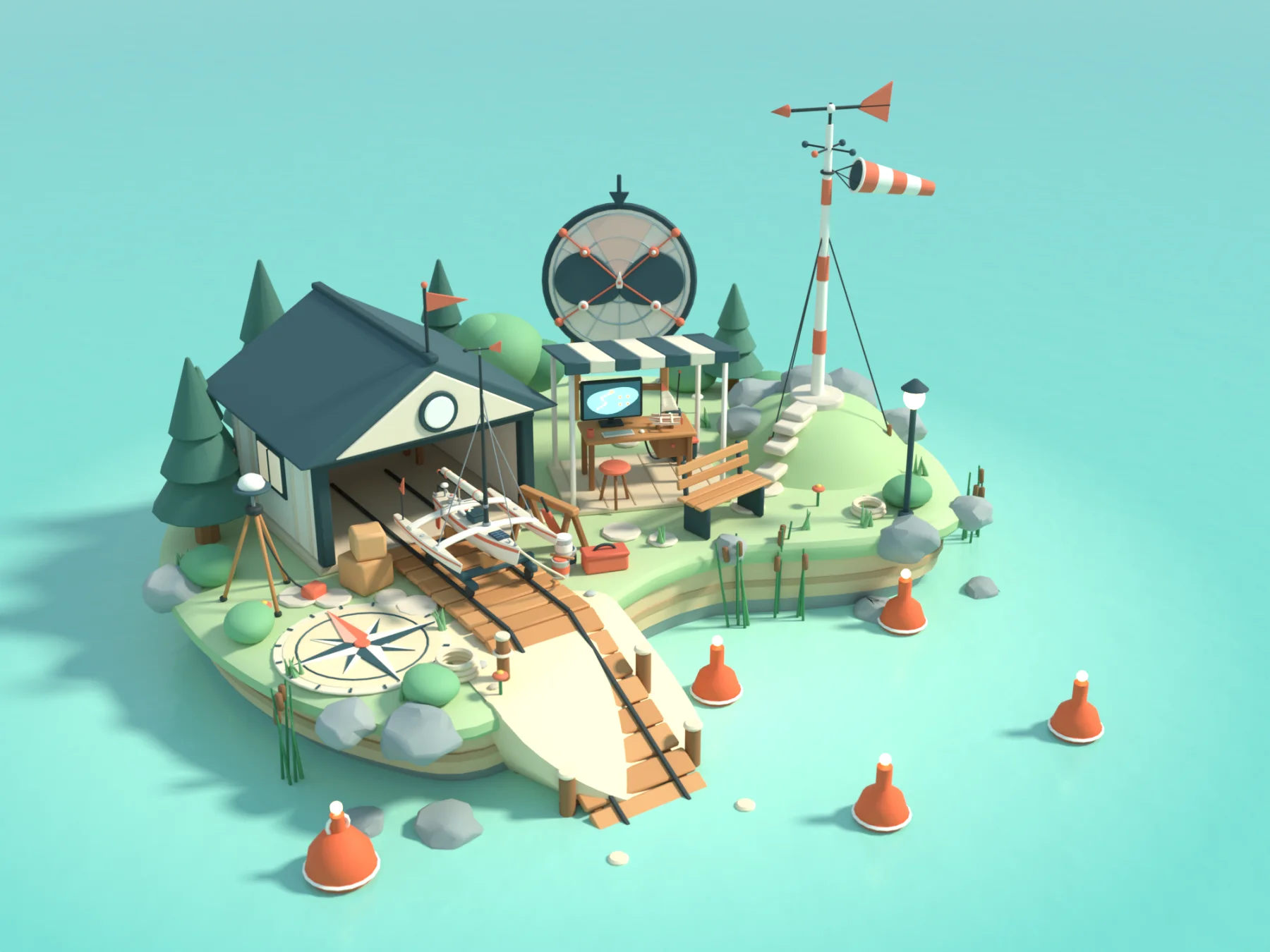
A lakeside test station, with the wind as the main character.
An illustration built for this site in Blender. It explains the idea; it is not data from the project.
An autonomous boat has to turn imperfect information into a physical decision. My contributions to Kehillah Sailbot focused on navigation, steering, wind filtering, state estimation, and the simulator used to study the boat’s behavior. The little boat that carries you between the islands on this site’s front page is modelled on the team’s simulated trimaran.
Closing the loop
The team’s system runs on ROS 2: sensors publish GPS fixes, wind direction and inertial readings; a navigation node decides; rudder and sail commands leave on their own topics. I contributed to the software between those ends: smoothing the wind reading and flagging gusts, estimating the boat’s state, and turning a desired heading into commands.
Where to point, given the wind
A sailboat cannot sail straight into the wind. The team’s planner reads a polar table of boat speed against wind angle and uses its best angles (49.3° off the wind going upwind, 124.4° going downwind) to decide when a course needs a tack and where the turn should happen. The baseline sail trim is a simple proportional rule, and the boat on this site’s front page uses the same one.
Respecting physical constraints
My model-predictive steering work predicts the boat’s heading a few steps ahead with a first-order yaw model and chooses rudder moves that keep the heading error, the turn rate and the rudder effort small. The rudder’s ±21° travel and its maximum rate are hard constraints, and heel beyond 25° is penalised. The model’s constants are assumed defaults, not values calibrated on the water.
Estimating what cannot be measured directly
A square-root unscented Kalman filter tracks ten quantities, including position, heading, speeds, heel and both actuator angles, from GPS, compass and inertial measurements. A separate sail optimiser uses lift and drag relations, including a post-stall model, to suggest trim and to ease the sail as heel builds.
Learning in simulation
The team’s physics simulator models a 15 kg trimaran on a small lake, with lift and drag on the sail and hulls taken from published coefficient tables. My work there was engineering hardening: input validation, error handling, logging and typed constants, so that a wrong configuration fails loudly instead of producing a plausible-looking run. Nothing in this page is an on-water result.
A decision becomes a rudder angle.
- 01
Connect the control loop
The team’s ROS 2 architecture separates sensor input, navigation, and actuation. GPS fixes and wind direction feed the control system, while rudder and sail commands travel on dedicated topics. That separation makes the data entering a decision and the command leaving it inspectable.
- 02
Constrain the next move
The steering controller minimises a cost over a ten-step horizon: heading error, yaw rate and change in rudder angle, with a terminal heading term. It is solved under a rudder limit of ±21° and a slew limit of 15° per second, so the plan only contains moves the servo can make. If the optimiser fails, the proportional controller remains as the fallback.
- 03
Study behavior before deployment
The simulator integrates forces of the form ½·C·ρ·v²·A on each foil with several sub-steps per time step. It connects the software question (what command should be issued?) with the physical question of how the boat responds. Parameters in the controller and the simulator do not yet agree with each other, and reconciling them is open work.
The repository documents the team’s ROS 2 system; the event framework, tack planner and baseline controller are the team’s. My contributions focus on navigation, steering, wind filtering, state estimation, and simulation. A later automated test run in the repository passed only a minority of its cases because of import errors, which is recorded rather than hidden.
Explore the sailboat control repositoryThe honest edges.
- No competition or on-water performance is reported here. The work is simulated or desk-tested.
- Improvement figures in the repository’s planning documents are projections, not measurements.
- The controller’s boat model uses assumed constants and has not been calibrated against the real boat.
Navigation at work.
English audio. Captions are available in all ten site languages; translations are machine-assisted.
Read the transcript
Playback could not start. Try the video controls or download the video.
An excerpt from my portfolio film showing the Sailbot simulator, boat controls, and a simulated route. This is a software demonstration, not footage of an autonomous boat on the water.
Where this connects.
 Language in motionControl of a body with limits: a rudder’s travel here, the joints of two hands there.
 A better test for an agentSimulate and qualify before spending real resources, and write down what the tests actually said.
 Beyond the heat mapBoth begin by cleaning a noisy environmental signal before deciding anything.
The island is an illustration. This page describes software contributions and does not report unverified competition or on-water performance.