Releaf
Small actions. A lighter footprint.
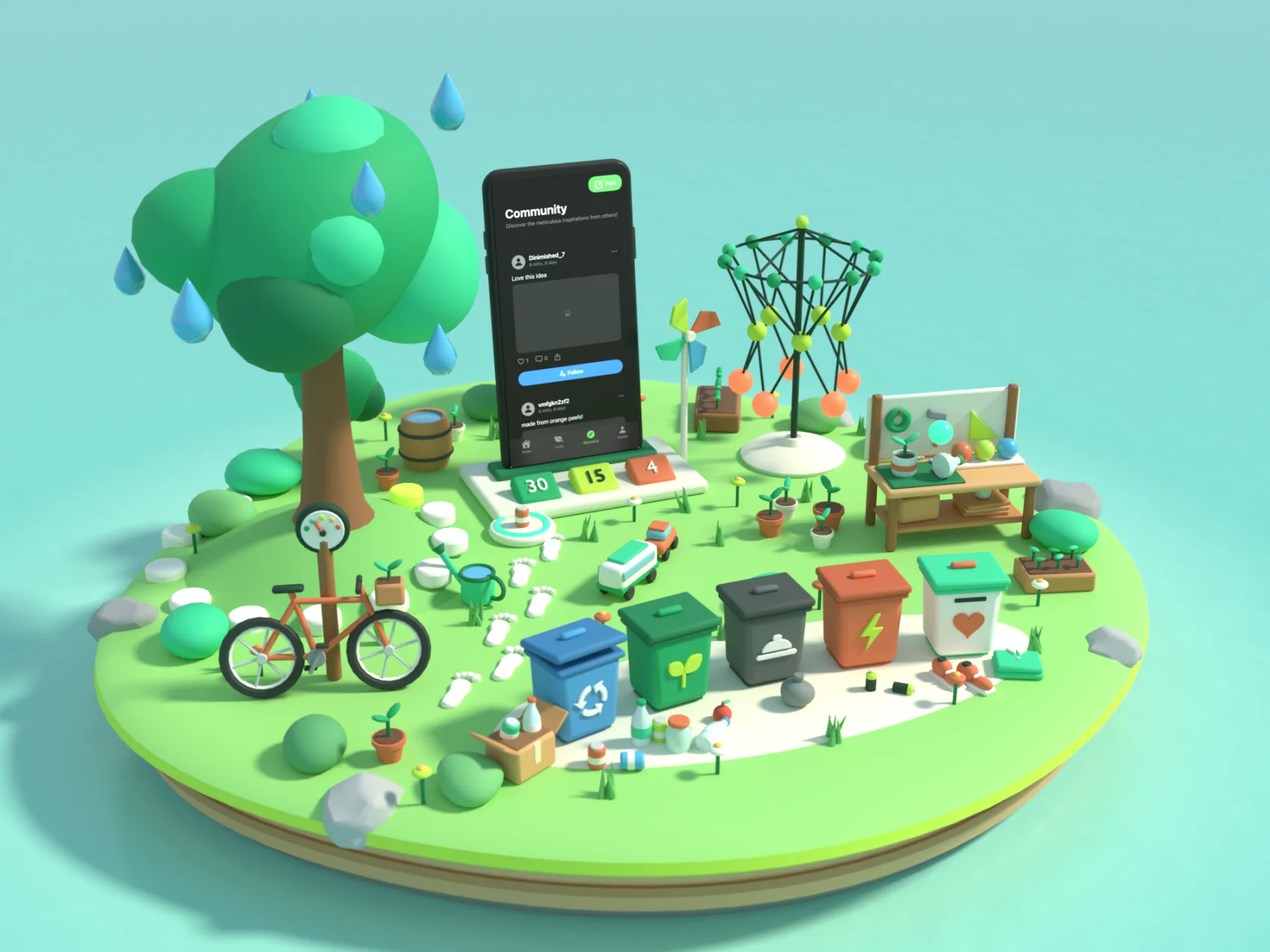
A phone, a tree and five places for things to go.
An illustration built for this site in Blender. It explains the idea; it is not data from the project.
Sustainability becomes more approachable when the next step is concrete. I helped build Releaf around the things people already have, the habits they want to change, and a community to share those experiments with. Under the friendly surface, the app is an exercise in putting machine learning where it is useful and keeping it honest about what it knows.
From information to a daily habit
Releaf brings together ways to reuse everyday materials, an estimate of the carbon a person’s day produced, and a community for sharing what worked. The aim is to give environmental information a useful place in a routine: an idea to try, an action to record, or something to show someone else. Progress is drawn as a tree that grows through eleven levels, and rewards are counted in water drops.
A classifier that lives on the phone
The app’s current code recognises waste with an EVA-02 Large vision model converted to Core ML. One image passes through three output heads at once: 30 item classes, 15 materials and 4 bins. Running on the device means a photo does not have to leave the phone to be useful, and a prediction below a set confidence is flagged rather than presented as certain. If the on-device model is unavailable, the app can fall back to the same classifier on the server.
A small graph instead of a large model
A name is not yet advice. Releaf ships a knowledge graph of 43 nodes (30 items, 8 materials and 5 destinations) joined by 118 edges, with embeddings learned by a graph attention network. Disposal guidance is a lookup along the graph’s edges; “similar items” is a cosine similarity between embeddings. Moving search onto this graph removed the app’s dependence on an external language-model service for that feature.
Carbon tracking that separates guessing from arithmetic
The carbon tracker is opt-in. Location and motion readings are summarised on the phone into 15-second windows, and only those summaries are uploaded. A calibrated classifier infers the travel mode and reports “unknown” when its confidence is low. A separate, auditable step then multiplies distance by published emission factors. The classifier was trained on a physics-based mobility simulator, so its near-perfect simulated accuracy is not a claim about real phones.
Building with a team
As a cofounder of Rematter Cooperation, I worked across the SwiftUI app, the Django backend for accounts, rewards, achievements and notifications, and the supporting AI services. We raised $2,000 in funding and earned a top-two team placement in the 2025 China High School Social Innovation Competition and Incubation Camp. Releaf reached more than 5,000 downloads.
From a photo to a useful next step.
- 01
One image, three questions
The EVA-02 Large classifier takes a 448 × 448 image and answers three questions from a shared representation: what the item is, what it is made of, and which bin it belongs in. Accuracy on held-out images ranged from about 90% to 94% depending on the evaluation set, with food waste and glass bottles the weakest classes. The model was exported to Core ML at 16-bit precision for the phone.
- 02
Guidance by graph lookup
A graph attention network (GATv2) learns a 64-dimensional embedding for each of the 43 nodes. The app ships the graph as plain data, so turning a prediction into guidance is a neighbour lookup and a similarity search that work offline. Similarity scores rank candidates; they are not calibrated probabilities that a reuse idea will work.
- 03
Useful under partial failure
The supporting services split the work between a gateway, vision, retrieval, a knowledge graph and a response step. The orchestrator marks a response as partial when a service is missing, and a fallback path keeps a simpler answer available. An unavailable capability is reported instead of being papered over.
These details describe the app’s current code and its supporting AI repository, which reports staging readiness. They are separate from the released app’s download figures, and not every feature described here is confirmed as released.
Explore the supporting AI repositoryThe honest edges.
- Download, funding and competition figures come from my résumé. They are not usage or retention figures.
- Carbon numbers are estimates from distance and published emission factors. They are not measurements of a person’s real footprint.
- The travel-mode classifier has only been evaluated on simulated trips. Its accuracy on real devices is not yet known.
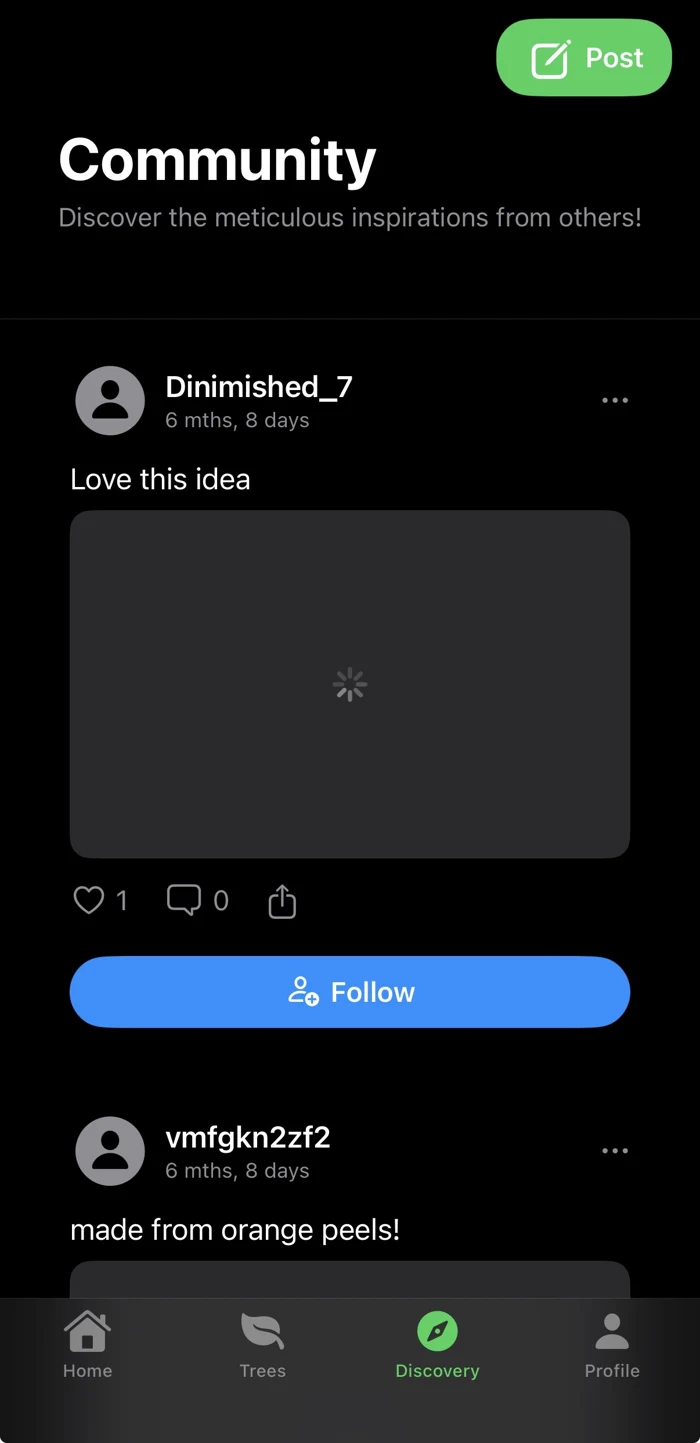
A feed of small, real actions.
The community screen from an earlier release: reuse ideas shared by people using the app. The same screenshot is on the phone that stands on the island above.
Actual app screenshot. Later builds reorganise the tabs around Create, Impact and Community.
Where this connects.
 CollegeAdvisorThe same pairing of a SwiftUI app with Python services, and the same rule: say “unknown” rather than guess.
 Finding a headingBoth train and test against a physics simulator before trusting the real world.
 Science, clearly toldExploreAid was a first attempt at turning a project into something people might use. Releaf is the one that shipped.
Download and funding figures are reported in my résumé. Carbon estimates are informational; they are not direct measurements of environmental impact.